**The Truth About Core Training:
Why Most Programs Fail — and What Actually Works**
For decades, the fitness world has thrown around the word “core” — every certification, trainer, and expert using their own definition.
But here’s the truth:
There is no standardized, industry-wide definition of the core.
Every organization defines it differently.
Almost all definitions are incomplete and outdated.
Some define the core as “abs + low back.”
Others as “everything between the shoulders and hips.”
A few include the diaphragm or pelvic floor.
But none of these definitions reflect how the core truly functions as a multilayered, neurological, structural, and myofascial system.
And when the foundation is unclear, the training built on it will always fall short.
That’s why:
back pain keeps coming back
workouts plateau
people never feel as strong or stable as they should
The problem isn’t your effort.
The problem is that the industry has never fully agreed on a complete, unified, anatomically accurate definition of the core — so it could never teach you how to train it properly.
What Everyone Misses
Most programs train parts of the core — abs, obliques, or low-back muscles.
But the core is not a handful of muscles.
It’s the integrated foundation of your entire body.
It’s what connects:
Upper to lower body
Left to right
Front to back
Your joints, posture, breath, and balance
Your movement, strength, and stability
Without a unified core, nothing else works the way it should.
That’s the gap the industry created — and the gap my Total Body Core Model™ fills.
Introducing the Total Body Core Model™
The Total Body Core Model™ emerged after decades of:
Studying biomechanics, alignment, neurology, fascia, and movement science
Working with thousands of real-world clients
Seeing the same patterns in pain, weakness, and movement breakdown
Rebuilding bodies from the inside out — often after everything else failed
This model is the backbone of the Fusion Fitness & Performance™ system and the Core-to-Strength™ method.
It finally defines the core the way it should have been defined all along — as a 4-layer integrated system.

Conceptual illustration of the Total Body Core Model™ — © 2003–2026 Fernando Paredes.
Published in the peer-reviewed medical journal Cureus and now indexed in PubMed Central, PubMed (2026).
Read the full published article on PubMed.
Layer 4: Peripheral Sensors & Amplifiers (Hands, Feet & Breath)
This is where your core is most strongly influenced — the top of the system.
Your hands, feet, and breathing patterns act like neurological switches that instantly change how your core fires.
Every step, every grip, every breath either:
Amplifies your core
Or shuts it down
These sensory gateways determine whether the deeper layers can activate the way they’re supposed to. When this layer is weak, sloppy, or uncoordinated, everything below becomes unstable.
This is why improving core strength always begins with improving sensory input.
Layer 3: Myofascial Anchors (Upper & Lower Cross-Bridges)
These diagonal and spiral chains connect your entire body — shoulders to hips, upper to lower body, right side to left side. These connections include multiple myofascial continuities — spiral, lateral, and deep stabilizing lines — working together as a distributed tension network.
They are the “force transfer highways” that allow power to travel through your entire system in real-world movement:
Throwing
Rotating
Walking
Lifting
Running
Athletic patterns of any kind
If these chains are weak or imbalanced, power leaks everywhere and the lumbar spine takes the hit.
When activated correctly, they unify the whole body, creating smooth, controlled, powerful movement.
Layer 2: Structural Core (The Lumbopelvic Hip Complex)
This is the center of gravity and the structural engine of the entire body.
The spine, pelvis, and hips determine:
Your alignment
Your posture
Your movement efficiency
And your long-term joint health
This is where most people experience pain or dysfunction — and where most fitness programs fail to create real change.
When Layer 2 is strong, stable, and coordinated, the entire body can move freely and powerfully without compensation.
Layer 1: Deep Core Stabilizers (The Foundation)
These are the deepest muscles of your body — the ones you can’t see in the mirror but feel when something goes wrong.
Muscles like:
Transverse abdominis
Multifidi
Diaphragm support muscles
Pelvic floor muscles
These don’t produce big movements; they create stability, protection, and internal pressure management.
The deep core is your foundation.
When it’s weak or offline, every other layer is forced to compensate — leading to stiffness, collapse, and chronic pain patterns.
When it’s restored, everything above it becomes stronger, smoother, and more coordinated.
Why This Order Matters (The Real Sequence)
Most people think the core fires only when you consciously “brace,” but modern motor-control research shows something far more powerful:
✔ 1. The deep core fires first — automatically and inside-out.
The TVA, multifidi, diaphragm, and pelvic floor activate milliseconds before any limb or trunk movement.
This reflexive stabilization happens before you even think about it.
This is why real core strength must begin with Layer 1.
✔ 2. Then the outer layers respond — guided by sensory input from the hands, feet, and breath.
While Layer 1 fires first, the quality, strength, and coherence of the entire system is shaped by Layer 4.
Your sensory systems don’t start the sequence — they amplify, organize, and refine it.
✔ So the real truth is this:
Stability begins inside-out.
Optimal movement requires outside-in integration.
Most programs train the outside layers (big muscles) without ever training the deep inner system — and that’s why people stay stuck in cycles of pain, imbalance, and plateaus.
The Total Body Core Model™ finally brings the entire chain together.
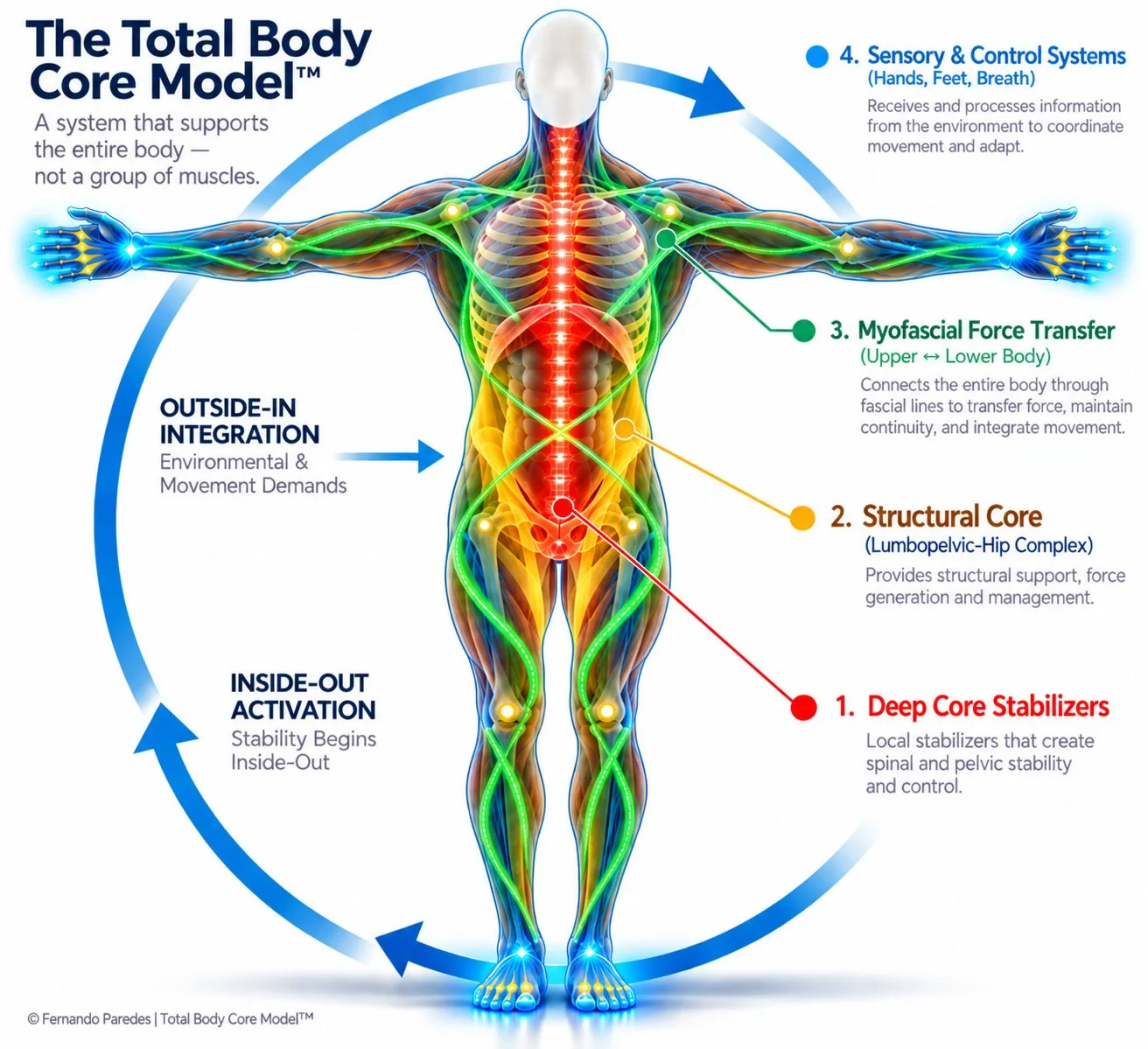
Conceptual anatomical illustration of the Total Body Core Model™.
Colors and pathways represent functional layers and relationships rather than discrete anatomical boundaries.
Why It Matters to You
When all four layers are trained together — the way the body actually works — the results are profound:
Better posture
Stronger, more stable spine
Reduced back, hip, knee, and shoulder pain
Faster recovery
Smoother, more efficient movement
Strength that transfers directly into daily life and sports
Long-term resilience and confidence
This is core training that finally makes sense to your body.
The Fusion Difference
This isn’t a trend, theory, or gimmick.
The Total Body Core Model™ has been used inside Fusion Fitness Studio for years:
on adults over 40
on people recovering from pain or injury
on high performers
on triathletes and elite athletes
on clients frustrated by everything else they tried
It works because it reflects how the human body truly functions.
While the industry has offered many partial definitions of the core, it has never created a unified, multidisciplinary one that actually reflects how the body works.
So I built the model that finally does.
For years, I assumed defining the core was the job of a multi-disciplinary committee — not a solo practitioner.
But again and again, rehab professionals, doctors, and clients told me the same thing: ‘If the industry won’t define the core, you should.’ Their encouragement wasn’t about ego — it was about stepping up to fill a gap that had been empty for far too long.
I didn’t create the Total Body Core Model™ to sound “cool”. I created it because the lack of a unified definition was hurting real people — and no one else was stepping up to solve it.
Your Next Step
Ready to understand what your body has been missing?
👉 Schedule Your Complimentary Consultation
Let’s see what your core is doing — and what your body is capable of.

Sept 1, 2025